
Collaborative Robotics: What are these and what are we doing?
Industrial robots must meet all kinds of safety requirements. First of all, to ensure the safety of people. For example, an industrial robot must be stopped automatically if a person enters the work area, thus entering the security zone. The industrial robot is often performed in bright colors, surrounded by security gates and perfected to apply one operation (usually) quickly and perfectly. The collaborative robot works with people and depending on the type, these robots are lighter, more compact, handy, and can perform multiple operations. What are collaborative robots now exactly and what are we doing?
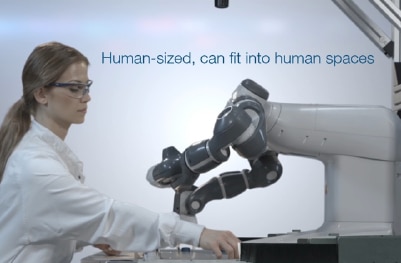
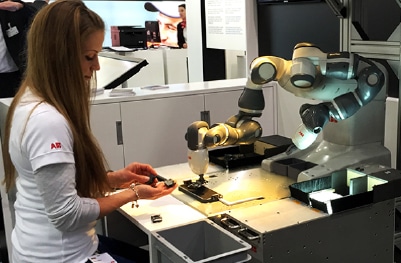
4 types of collaborative robot
According to international standards ISO 10218 part 1 and part 2, there are four types of functional collaborative robots, of which type 4 is the most ‘collaborative’. Type 1: Stoppable Safety Stage Type 2: Manual Learning Movement Type 3: Security Monitoring with Custom Speeds and Suspension Type 4: Fully Guarded Power and Speed
Type 1: Security monitoring with standstill. This robot is distinguished from the ordinary industrial robot, because there is an additional security facility that detects employees in the robot’s work area. When entering the work area, i.e. the safety zone, the robot will stop and the brakes will be activated. The robot will not turn off. It should be understood that this application is only effective if the interrupt time is minimal. However, it is intended that the robot is used as efficiently as possible to be profitable.
Type 2: Manually learning movements. This function is to manually learn the movement patterns of robots. In particular, complex actions of product parts in a small area are extremely suitable for manual learning. This industrial robot must be suitable for this function and be equipped with additional features and tooling on the clutch for the gripper. This tooling must be capable of measuring and transmitting all the manual forces that are exerted on the robot to the robot control. The robot must be enabled in special mode, after learning, it will be disabled and the work area is a dangerous area again. During operation, the work area is therefore not safe for employees.
Type 3: This feature is for industrial robots that use part of the same area of work as the employees, and also regularly enter the work area by employees. This requires laser scanners, or other similar vision systems, which continuously monitor the position of the employees. The robot is assigned a number of zones in advance to which different speeds of the robot are linked. Depending on where the employees are located, the robot will adjust its speed, the closer the employee gets to the robot, the slower the robot will perform. If the employee gets too close, the robot will stop. It is an automatic system and will therefore start again and / or adjust the speeds. Unlike the previous types, the robot’s work area is safe for employees.
Type 4: This robot is a real ‘Cobot’ and not a regular industrial robot. The robot always works in the same mode and does not match the presence of an employee. There is no need for additional security, so there can really be cooperation. The robot is constructed in such a way that it can measure and adjust all forces externally on its axes and deviate from the normal situation (these are learned in advance) when there is a risk of danger. Also, the mechanics are designed so that the forces can be divided over as wide a surface as possible. The design is as close as possible and drives are fully integrated into the mechanical arms, so no excellent obstacles. Due to the limited power play, the speeds and possibilities are limited. The robot does not require additional security features and always ensures a safe working area for the employees.
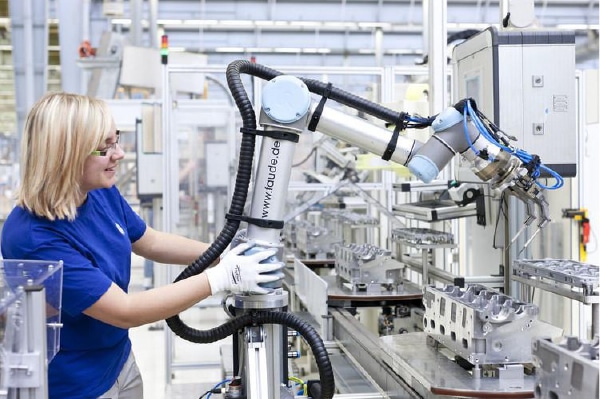
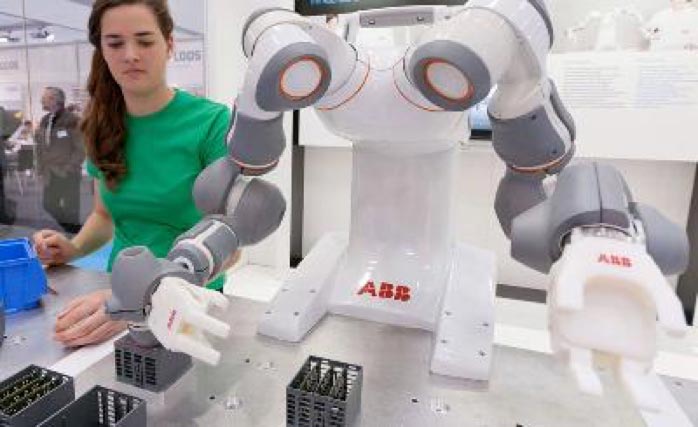
When is the cobot suitable?
The first 3 types of collaborative robots, with the exception of the described adjustments, are regular robots and therefore no news on the horizon. Otherwise, it is the fourth type of robot (cobot), and we would like to go into this. A cobot is able to adjust the speed of its actions (and speed is relative, keep calm and controlled movements), and with its very moveable arms, colleagues can get a helping hand. The ‘programming’ of this is comparable to the type 2 collaborative robot and thus becomes quite simple. So, for short-term repetitive operations, you can apply regular robots, in difficult operations, with a shortage of hand or heavy or very precise operations, it is advisable to use The cobot. This helping hand can repeat actions endlessly and does this very appropriately and without mopping !. This makes the cobot a useful and always helpful colleague.
The cobot in services & consumer products
In the service, the cobot sometimes looks human and replaces man as a whole. In Japan, the first robothotel is opened. You are welcomed by a robot, enrolled and receives your room key. It is noteworthy that a mechanical robot takes over the work of people in an industry where customer friendliness, personal contact and service should be paramount. Time will show if we want this. For consumer products, the cobot is usually completely invisible. This invisible cobot is currently very current and widely discussed. An example is the self-propelled car! Every self-respecting car manufacturer keeps busy with it and everyone wants to be the first, provided that politics does work naturally!
Is the use of cobots a hype or is it an irreversible process?
With consumer products it has already been built so that we are no longer in doubt about its potential applications and feasibility. Think of robot vacuum cleaners, lawn mowers and now the self-propelled cars. Many industry robots are used in the industry. However, here too, you can see the more exclusive products that a handy aid without vibrating hands and glasses appears to be highly desirable and economically feasible. In medical applications, the cobots have also proven their service for a long time, thinking of the use of complex operations where the surgeon still performs the movements but the cobot performs the actual operations. In our view, the cobot is certainly not a hype, but an irreversible development for perfecting operations or improving (working) conditions. The art is to apply it where it is also an improvement and the cost outweighs the benefits.
Z-tech Solutions and Cobotics
Collaborative robotica certainly has our attention and we see opportunities. An example: from semi-finished products in relatively limited numbers, but with a considerable cost price, we often use semi-automatic tooling with a fairly product-specific character. These are parts that often consist of many different components and must be assembled around. We see here opportunities to limit product-specific recordings and all actions that entail this by using cobots for this purpose. Reuse and / or quick small adjustments are simply and financially a lot more attractive. We also realize tooling with much less movement and thus the possibility of malfunctions. It is completely in line with our way of thinking out of the box.