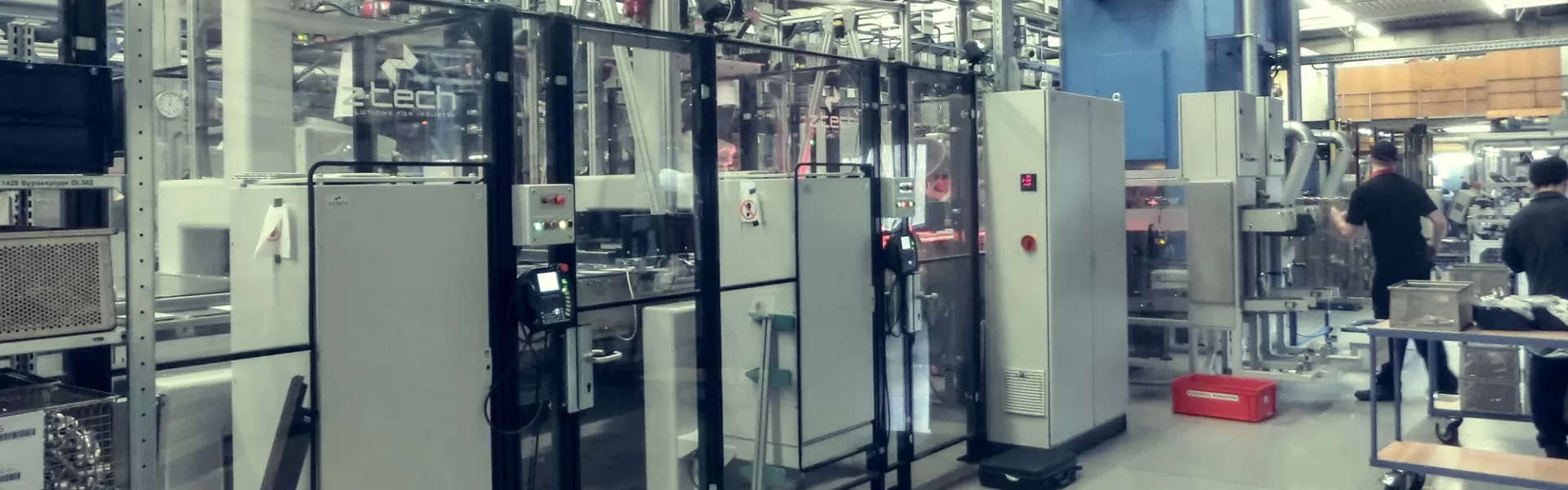
Assembly line for air and oil coolers
Scope222
Turnkey delivery;
- Feasibility study (technical and commercial).
- Draw up specifications.
- Concept, technical design, construction and commissioning
Purpose
Benefit for client;
- Flexibility necessary for large variety of products.
- Minimal switching times by menu choices i.c.m. Robotic programs, only exchange highly product-specific parts.
- High degree of reliability, so quality-enhancing.
- Low production costs (labor costs and availability) due to far-reaching automation and increase capacity.
Goal
Fully automatic assembly of various types of oil and air coolers, with repetitive packages of different parts to be stacked.
Issue
The challenge is the wide variety of types and embodiments, with the system being also suitable for new variants in the near future. In addition, high demands are placed on reliability, reproducibility and capacity of the installation. The capacity of an installation is also determined by the speed of installation and the amount of time loss due to switching times to another type of cooler. The components of a cooler have a very high air permeability and can only be picked up with high airflow and thus a high vacuum. Mechanical grabs are too slow and cause damage to the very fragile parts and only vacuum is not sufficient due to these product features. E.e.a. Causes relatively high masses to be handled and a Delta robot is not eligible for this. The work area and the required accuracy are insufficient at a delta robot on the diagonal ends of the work area.
Approach
We have begun a theoretical model in which all input variables, based on the need, are included. Then we made a logistic simulation and a robot simulation (motion profiles and speed), from which the system’s limit values were created.
This installation has therefore deliberately chosen the very fast scara robot of the Staubli brand. This because it is specifically designed for very high speeds in combination with relatively high masses and yet the benefits of maintaining a 4-axis scara robot.
In the automotive market, the concept of Zero defects has become a standard, which necessitates additional quality controls throughout the process through highly accurate vision systems. The reasoning is simple, if you perform each step and reproduce it, you can assume that the final result of the set requirements meets and continues to meet. Afterwards, a lot more difficult or even sometimes impossible because in a completely assembled product the components are no longer visible and / or accessible.
In de automotive markt is het begrip Zero defects een standaard geworden waardoor extra kwaliteitscontroles gedurende het gehele proces middels zeer nauwkeurige vision systemen moeten worden doorgevoerd. De redenatie is eenvoudig, als je iedere stap gecontroleerd en reproduceerbaar uitvoert, kun je ervan uitgaan dat ook het eindresultaat aan de gestelde eisen voldoet en blijft voldoen. Achteraf is een stuk moeilijker of zelf soms onmogelijk omdat bij een geheel samengesteld product de onderdelen niet meer zichtbaar en/-of benaderbaar zijn.